A Writer’s Corner – Advice for someone with anxiety who hasn’t begun to write.

It is inspiring to listen to successful writers talk about their craft. Masterclass has some amazing classes by authors; I’m sure many can be found on YouTube.

Learning to craft a good story will be a tremendous help before the work begins. Don’t be afraid to ‘fail’. I hate that word because we learn so much through trial and error, and writers will need to learn when to give up a project that is going nowhere. Sometimes, the best decision is letting go of what you have written and starting again.


This can be a wonderful adventure.

A Writer’s Corner – Why do you write?

Writing has always been my favorite form of communication. I would rather write than speak. I would rather read than listen. I am visually oriented. What I read becomes a movie in my head.

My imagination is a wild, untamable thing. It always has been. I made up stories and illustrated them as a child. Playing with dolls involved elaborate storylines and characters. It was an ongoing, epic Barbie drama. I played with dolls for a very long time, acting out the drama in my head.

That drama never stopped. It became creative visualization, a way to soothe myself or a cure for insomnia. Always imagining, building fantasy in my mind. Self-soothing. My characters and their drama had to be as unlike my life as possible, so historical romance was the preferred genre.

There you have it.

A Writer’s Corner – when to rewrite

A question came up on when an author should do a rewrite.

I actually finish the whole storyline (not all the writing), and then I see what’s missing or needs better explanation.

In my novel in progress, Daring to Marry the Duke, I wrote all the pivotal scenes first and sketched out the rest, and then realized that a lot more explaining was needed, and I had to add new scenes and alter a few.

I wrote the entire book sequentially in A Misalliance with Love, which I think was a mistake. It was very difficult to go back and change things.

A Writer’s Corner – The end of the story

How do you know how your story is going to end? Was a question that came up on Reddit. “Are you writing your story with an ending in mind or do you prefer to let things unfold as the story continues?”

Some of the answers are really interesting. Many people say the beginning and the end are solid; it’s the middle that causes problems.

I know the end, struggle to begin, and have the major plot points already in mind before I start writing.

I would be nervous about writing a book without an ending. The end is like a target, and you keep shooting until you finally hit the bull’s eye.

A Writer’s Corner: Too Many Opinions Spoil the Book

A recent Facebook post was from a writer who sent their book for professional editing and received great feedback. They then distributed the book to Beta readers and were appalled that the responses were varied and contradictory. Was it a case of too many cooks spoiling the broth?

My question for this author was: When you read your book, do you actually enjoy it?

Yes, the answer was yes. So, isn’t that good enough? I understand that overwhelming doubt that seems to come from nowhere, triggered by the least little thing. Grammerly did me in when I was writing my first book. I began to trust the tool more than my own instincts. So many conventions are no longer a la mode: adverbs, passive voice, commas. I ignored the fact that I disagreed. None of these things detract from a good plot. Is reading reduced to finding fault with grammar, sentence structure, and the lack of clever analogies. I am enthralled by a good story written in the author’s true voice. I would rather admire that than a clever turn of phrase.

I did give the OP my thoughts on their dilemma. I don’t think relying on other people’s subjective opinions is particularly beneficial. There will never be a consensus. We all have our preferences, and to allow too many people to influence your work is a recipe for disaster.

Since they had feedback from an editor they deemed ‘amazing’, the book was ready for publication. Some people will love the book, and some people won’t. There is no perfect. Flip the switch and put it out there.

A Writer’s Corner – Question to all writers: How did writing affect your mental health?

An interesting question came up in the r/writing subreddit. “Question to all writers: How did writing affect your mental health?
I hadn’t really thought about my mental health during the process of writing a book. But of course, mental health would be affected. After pondering this, I realized it helped, and it hurt.
The first book was cathartic because when I was done, I realized I had put far too much of myself into my character. And that made me examine a lot about my life. Understanding is always a good thing.
But it’s not just about the writing. The entire process affects me in unexpected ways.
I have a naturally nervous disposition, and writing calms me, as does painting or anything that completely engages the mind. That’s the good part.
From the moment I start thinking about a story, no other worries invade my thoughts. Writing is like opening a box of chocolates and wondering which one I’ll have today. Which part of the storyline is speaking to me at that moment? Letting my imagination run riot is like Christmas, and I’m opening one package after another. Ideas careen around unchecked. The actual writing is a challenge I love.

EUPHORIA.
Things start to get tense and nervous jitters begin during the editing, and the tension ramps up after publication. Editing and using Grammarly makes me doubt my writing skills and trust that this machine editor is right and I am wrong.
DOUBT.
Dealing with post-publication completely rains on the parade. I find myself in a state of anxiety and self-doubt, judging myself by the number of sales and reads (or lack of). It feels like I am at work, waiting for a performance review. And I feel like I should have the metrics to judge my success or failure. The worst feeling.

JUDGEMENT.
My next book will be different. I’m reminding myself that I’m in this for the love of it. Some may like it, and some may not. More readers would be wonderful. Sales would be great, but lacking that doesn’t mean it’s not a good book. I’ll keep at it.

A writer’s dilemma: To the finish line.

In a Facebook group, a writer asked the question: “I have about 20 ideas in various forms of completion and I see new things everyday. How do you organize all your creative ideas? And how do you choose what to work on and in what order?

Yep. It’s hard. And you have to make hard choices. I’m a big fan of working on things you feel inspired to work on at the moment. If you don’t put your fingers on the keyboard or pen to paper when you are really feeling it, you might lose that thought, that perfect phrase or mood.
Creativity and inspiration can not be turned on at will, so you must capture it.

BUT. HOWEVER. AND.

You need to bring something to the finish line.
I know that in order to actually complete something, I must pick one thing and work on that every single day until it’s finished.

Sometimes it seems like a chore. Sometimes it’s hard to concentrate. But I chip at it daily.

This morning I worked on only one scene in a chapter in my next book. It’s a pivotal chapter, and I stepped in the protagonist’s shoes and walked through it, thinking of things that were not in the rough draft.

It was a good day’s work. I could have done more, but something else was niggling at me, so I moved on to a short story I was writing and fleshed it out.

That’s ok, as long as you concentrate part of your day on what will be published next. No matter how many chaotic creative thoughts whirl around in your wonderful imagination, finish something.

Simply carving out a part of your time for the main project while still spending some time on whatever strikes your fancy works just fine. It could just be proofreading or doing a read-through out loud. But you must do something.

I have to work this way so I don’t suppress creative inspiration and, at the same time, dedicate myself to completing at least one idea.

A writer’s dilemma: Adding character flaws

There was an interesting thread in the Reddit writing community about how to avoid making a character too perfect. (How can i avoid writing/creating Mary sues)

The comments and suggestions were great and well worth a read. The consensus was that the character must be given a flaw or a weakness. I agree and believe the flaw is most interesting when it interferes with the character’s goals. This is important for secondary characters as well.

I find male protagonists often painted as either totally flawed or too perfect and unattainable. Female characters who are imperfect are far more interesting, particularly if the writer allows the reader to discover why they have these imperfections.

The character I’m writing now is a bit of a Pollyanna, saved from being unbearable because, although she does good, she complains about it and wants to stop being forced to do good. Her escape route from this life makes her look like an opportunist. Not a good look, but somehow, you can’t hate her for it.

Rosie, in A Misalliance with Love, listens to other people’s conversations and is too rigid in her thinking, and Sinclair is trapped by his family’s past.

There are so many ways to take the shine off of a character to show they are not so perfect after all. It’s even more interesting if this is revealed slowly.

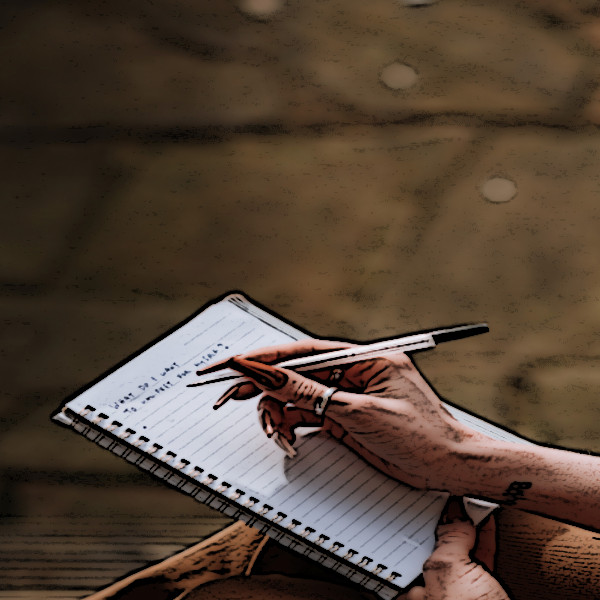
Image generated by Canva and digitally manipulated.

A writer’s dilemma: When do you abandon your book?

There was a pretty interesting discussion on a writer’s subreddit where someone was at 30,000 words into their book and ready to abandon it.

I really related to this.

I once abandoned a book at 40,000 words and then realized months later that the book really had no plot, and I hadn’t given the characters any likable personality traits. They were just going through the motions.

I moved on and became obsessed with another plot. That one was finished and published. Maybe one should go back to the basics of why they want to tell a particular story. What is compelling about the characters, and why are they even there? Give them a reason to live and then something to survive.