A writer’s dilemma: Motivation

Someone in a writer’s group posed the question – Does your main character need to have an intense motivation for something? What does your character want? The Op’s dilemma was that her character didn’t want anything – until the end.

It seems to me lack of clear motivation means the character is on a journey of discovery. Perhaps the character is running away from something rather than running to something.

That’s perfectly legit and quite good as long as the ultimate goal is hinted at along the way. We need that trail of breadcrumbs. The end goal shouldn’t seem like something pulled out of thin air. In the end, the reader should feel that what the character finally wants makes sense, given their history.

My characters have strong goals. In A Misalliance with Love, Rosie needs a home and family but has a burning, almost crippling desire for independence. Sinclair Talbot wants validation and esteem.

In my next book, Guinevere wants family, stability, and appreciation. The Duke wants hope and love.

Characters are motivated by their desires even if they do not yet know what those desires are.

Rosie and Sinclair must talk-A Misalliance with Love.

Rosie sat by herself in her favorite armchair by the fire with an unopened book in her lap.

She had hoped he would grow to like her. Instead, he had burst in talking about bills and people visiting her when he had never shown any interest in what she had planned. He never asked her how she would staff the house. She had tried to keep him informed about the modifications.
Rosie took a sip of her port, feeling the warmth spread through her body. She had been dreading this conversation since they sat down in the library, but she knew it was necessary.

A Misalliance with Love

Rosie’s thoughts-A Misalliance with Love

“Rosie knew that she had said some things to him in anger, things that she regretted now. When she had asked him to leave her alone, she had not meant it in the way that he had taken it. But it seemed that he was too proud to reach out to her or too ashamed of her to even consider trying to make things right between them. She knew that he would never have chosen her as a wife if it were not for the horrible incident at the Sunderland Ball . . .”

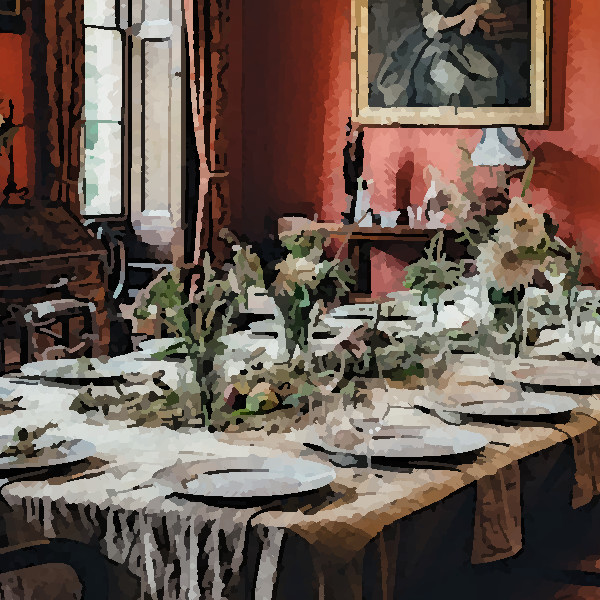
Dinner scenes make me so hungry!

One thing I’ve noticed in historical romance novels is that the female main character rarely has a healthy appetite. Why is that? An author can describe a meal where course after succulent course is brought to the table, yet our heroine either has no appetite or has quickly lost it and ends up pushing food around her plate. Don’t these scenes make you hungry?

I confess that when I read these passages, I cringe. I want her to eat to her full and savor every bite and forget all the silly conversations that make her so nervous. Gorge yourself, girl!

Instead, she picks and prods at her food, sometimes not taking a single bite of a meal that sounds heavenly. This is the norm.
Just another little detail I never fail to notice.