A Writer’s Dilemma – Using a Pen Name

In a Facebook writer’s group and Reddit forums, this question comes up again and again: What are the pros and cons of using a pen name?

Many answers are similar, with the ‘pro’ camp weighing in that a pen name does the following:
-Allows you to establish your writer’s persona separate from your identity.
-Allows you to use different names if you write in different genres.
-It is easier to develop a marketing campaign that does not impinge on your personal life.
-You just might not want friends and family to read your work and weigh in if it really isn’t a genre they are interested in.
-Some authors mentioned that they did not want friends and family reading the naughty bits and viewing them differently.
-A pen name allows privacy.

Most of those reasons are why I had to use a pen name, having already self-published an unrelated work of non-fiction under my name.

The main drawback to using a pen name is for people who want their life and personality to be part of their achievement. Using a pen name precludes you from certain marketing efforts like book signings and interviews, I imagine.
One writer said this.
“The one thing I’d always advise new authors to do is consider publishing under a pseudonym. I published my first 3 books under my legal name, and it’s one of my biggest regrets.
You can always reveal your true identity later if you want to. But you can’t undo having published under your real name. Privacy is important and not something to take lightly.”

She further elaborated when asked for more detail.
“I became a private person with age. I don’t want to show my face, share my thoughts on things, etc. At least not attached to my real identity.
Another problem is if you google my name, my current address pops up on some website that shows voter registration. That’s scary. Most authors probably don’t have stalkers, but still… It makes me uncomfortable. Especially being a woman living alone in a big city.
I also dislike having every friend and family member seeing what I’m writing. I’ve felt awkward about sex scenes or violence knowing my dad or grandmother will read. I’ve held myself back from exploring interesting ideas because they were not family friendly enough.
Then there’s work… I was job hunting earlier this year, and it felt awkward that potential employers could see my work if they googled me. Some of my books have topics that could be offensive to certain people. I’m proud of these books, but I’d feel 1000x better if they weren’t attached to the legal name I need for job applications.
I’ve switched to a pen name, but the sad part about that is now I’m having to start over from scratch, and I won’t get to have my previous books as part of my backlist.
Pen names allow you to be as “out there” as you choose. Some authors use them but still show their face and identity, and some want to be totally anonymous. It gives you options. But if you use your legal name, that’s it… you’re out there.”

These comments were in this thread.

Using a pen name should be a serious consideration.

Only two of my friends know what my pen name is, and only two others know I’ve self-published a book. I can’t explain why I don’t want conversations with my friends about my work. If I knew they were interested in my genre, perhaps I would feel differently. I asked one of the two I trusted with this information to give me feedback since I value her opinion (even though historical romance is not her genre).

I got great feedback but heaved a great sigh at the fact that she knows me so well; she thought she saw too much of me in the character’s views. This was a little off-base, as everything mentioned was intentional and was only added because they are part of the story arc. This is what can be expected when people who know you read your work. They will see you in it, or they will try to see themselves or other friends and family in the characters. They will unconsciously look for this. And if you do model characters after people you know, they will be upset.

Pen names are the way to write whatever you want.
A Writer’s Corner – The end of the story

How do you know how your story is going to end? Was a question that came up on Reddit. “Are you writing your story with an ending in mind or do you prefer to let things unfold as the story continues?”

Some of the answers are really interesting. Many people say the beginning and the end are solid; it’s the middle that causes problems.

I know the end, struggle to begin, and have the major plot points already in mind before I start writing.

I would be nervous about writing a book without an ending. The end is like a target, and you keep shooting until you finally hit the bull’s eye.

A Writer’s Corner: Too Many Opinions Spoil the Book

A recent Facebook post was from a writer who sent their book for professional editing and received great feedback. They then distributed the book to Beta readers and were appalled that the responses were varied and contradictory. Was it a case of too many cooks spoiling the broth?

My question for this author was: When you read your book, do you actually enjoy it?

Yes, the answer was yes. So, isn’t that good enough? I understand that overwhelming doubt that seems to come from nowhere, triggered by the least little thing. Grammerly did me in when I was writing my first book. I began to trust the tool more than my own instincts. So many conventions are no longer a la mode: adverbs, passive voice, commas. I ignored the fact that I disagreed. None of these things detract from a good plot. Is reading reduced to finding fault with grammar, sentence structure, and the lack of clever analogies. I am enthralled by a good story written in the author’s true voice. I would rather admire that than a clever turn of phrase.

I did give the OP my thoughts on their dilemma. I don’t think relying on other people’s subjective opinions is particularly beneficial. There will never be a consensus. We all have our preferences, and to allow too many people to influence your work is a recipe for disaster.

Since they had feedback from an editor they deemed ‘amazing’, the book was ready for publication. Some people will love the book, and some people won’t. There is no perfect. Flip the switch and put it out there.

I wanted more Figaro in the story!

“Figaro’s attention quickly shifted to the miniature wooden horse he had found in the nursery. He nudged her side in a gentle demand for attention, and she dropped to the floor beside him, the skirt of her pale green day dress billowing around her. Laughing, she attempted to wrestle the toy from his jaws.”

Excerpt From: Dee Harper Lewis. “A Misalliance with Love.”

Published this week!

Neither of them welcomes the attraction they feel, and a marriage is out of the question—until one fateful night. They are worlds apart yet are a lot more similar than they realize, and must find a way to reconcile their different dreams and create a life together.

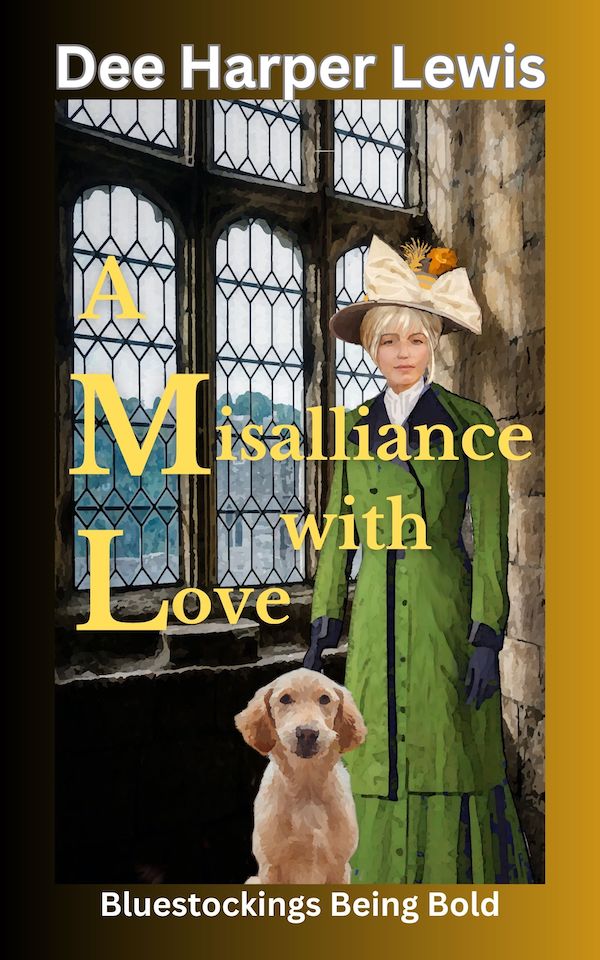
A Misalliance with Love was published on Amazon on July 1! YAY! It’s in the historical romance genre, about two people who are forced into marriage. The marriage kills their initial attraction because they think they are incompatible in temperament and ambitions. They are more alike than they realize and have quite a journey discovering this.

Summary: Rosamund Percey aspires to be a working woman and dreams of writing and illustrating children’s books. While she desires marriage eventually, she first wants independence. Meanwhile, she attends debutante balls and garden parties with her friends, catching the attention of a handsome but stodgy Marquess named Sinclair Talbot. Sinclair seeks a traditional wife to redeem his family name and support his diplomatic career, but he is drawn to only one debutante. Despite their initial resistance, a fateful night brings them together. They embark on a journey of discovery and must navigate their dreams to build a life together.

I like to travel – and my characters will too.

I have an insatiable wanderlust, as do the characters I create. Traveling is an escape from my ordered and sometimes constraining life, allowing me to immerse myself in the unexpected. It’s the thrill of witnessing the lives of others and stepping out of my comfort zone.

When I travel, I seek out good food, good wine, and the joy of discovering new destinations. Navigating through unfamiliar territories, I embrace local festivals, find local guides, and sleep in unusual places like a desert under the stars, a village hut, or the deck of a boat. I believe in sharing meals and breaking free from the isolation of anonymous cities, knowing that the rest of the world is not like that.

Traveling means turning my back on my comfort zone and embracing change, novelty, fears, and the beauty that exists in both man-made and natural aspects of life. It’s about finding art everywhere and returning home to books and brunches with friends. I let the wind guide me, constantly seeking challenges that make me feel brave. People-watching becomes a source of inspiration, yet finding the most peaceful places on the planet brings me a profound sense of tranquility.

Even when the unexpected happens, like a friend breaking their arm on vacation, we patch it up and continue our quest for the perfect beach. Travel evokes a mix of emotions – nostalgia for the past and excitement for the future. It’s a journey of progress, where disappointment in famous landmarks can be balanced by the excitement of overlooked gems.

And in the end, after all the wanderlust, there’s a special feeling of coming home, cherishing the familiar and reflecting on the memories created.

A Creative Journey!

What captivates me most in literature are the strong and independent female characters who navigate relationships with not only Alpha males but many different types of partners. This is my journey into Historical Romance. Through my books, I will explore love amidst adversity, emphasizing the challenges and possibilities that arise, and pose the timeless question of whether two individuals from different backgrounds can discover what they seek in one another.