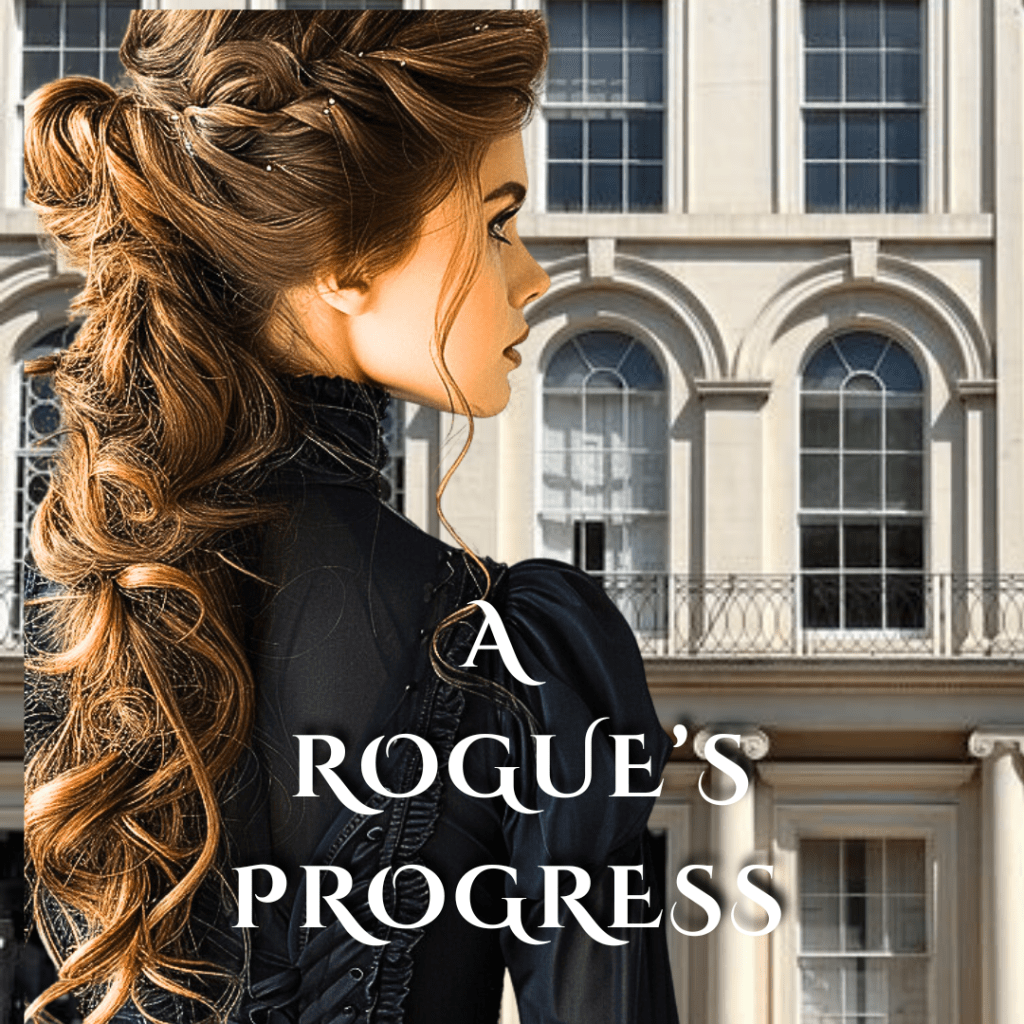
A Rogue’s Progress

An enemies-to-lovers Victorian romance. 

She’s a debutante searching for a husband. He’s a gambler chasing redemption. When their worlds collide over a family inheritance, sparks fly, secrets unravel, and desires ignite. In a game of love, luck, and betrayal, who will come out on top—and at what cost?

After six long years of schooling, Eleanor Bucknell is more than ready to enjoy a London Season and a chance for flirtation, love, and marriage. There’s just one problem—her impulsive and greedy brother has gambled away the family properties and is bent on arranging a prosperous marriage for her. With her plans thwarted at every turn, Ellie determines to make her own way in life, all the while plagued by thoughts of the rakish son of an earl who now owns the Bucknell property.

Casper Whittaker is a gambler and a rogue who feels no remorse when relieving fools of their property at the gaming tables. Besides, he is on a mission to redeem himself in the eyes of his father for his role in the tragic event that took his older brother’s life. Winning the Bucknell properties was the chance he needed to make a new life for himself—even though the plight of the feisty young debutante tugs at his heartstrings. 

Ellie never expected her greatest adversary to be the one man who could steal her heart. When a fiery clash of wills ignites between her and Casper, their undeniable attraction becomes impossible to ignore. But with her brother’s devious schemes threatening to tear them apart, will love be enough to overcome the odds?

This is a closed-door, sweet romance.
What makes a relationship romantic?

Trust: Trust is the foundation of a romantic relationship. It’s essential to feel secure and confident in your partner’s commitment, loyalty, and reliability.
I recently finished a Cara Devlin novel, ‘Nature of the Crime’, and one of my favorite scenes came near the end, where the main male character rescues the female main character. Even though it wasn’t expressed, I had such a strong sense that she wholeheartedly put her trust in him. He would find a way to help her, and she was not surprised when he did. This is a point in most romance novels that I find hopelessly romantic.

A Writer’s Corner – Writing Love Scenes

The love scenes are the most difficult scenes to write. In my books, I thought I handled the emotional part of desire very well but did not handle the Instalove and obsession well at all. This is so much a part of the romance genre, and it has always felt very unconvincing to me. It is very juvenile, yet it is so popular.
My characters are more ‘mature’ in that they don’t fall in love immediately. They are attracted, intrigued, and often baffled by this. There is a lot of wariness and uncertainty until the very end.
It’s hard to identify the moment when real love happens. We don’t even see when that happens in real life, so how can we capture that moment in a novel?
There’s a scene in my most recent novel, Marry Me, Duke, where the female main character all but begs her new husband to make love to her. That was such an enjoyable scene to write. For one, you don’t often see this in historical romance novels. Her lust and curiosity seem very real to me—as is his rejection. When they finally do make love, she takes the lead at first. And after that point, he gradually falls in love with her. That, to me, felt more realistic than Instalove/lust would have.

What makes a relationship romantic?

Shared Goals and Values: A romantic relationship flourishes when both partners have common goals, values, and aspirations. I love it when the two main characters are working together for a common cause. I love mysteries, and I’m a sucker for a good historical mystery where the female main character pairs up with a detective, and they work together, and sometimes against each other, to solve a crime, unravel a mystery, or save someone.

A Writer’s Corner – Should a person who is not a romantic write a romance novel?

An editor in the R/writing sub Reddit asks the intriguing question, “Who are you writing for?”
They went on to say that they’re not writing for themselves because their goal is for other people to read their work. I totally get that. And OP goes on to say that they’re not writing for others either because they don’t want other people and those opinions to affect their work. I get that, too.
“However, without a clear picture of for whom I’m writing, I am still writing.”


That’s the thing, isn’t it? Sometimes, we just don’t know what motivates us to write. But this post got me thinking.
Initially, I started writing purely for myself. I needed to get all of these characters and scenarios out of my head, so I thought, why not publish them? It’s an exorcism of sorts.
Then I discovered that the process was a lot of fun—more fun than doing my other hobbies. It became the most enjoyable use of my spare time.
I love developing the characters, getting into their minds, and building their world.
Then, I published my first book and discovered the world of self-publishing. I was immediately resistant to marketing and branding. I hated the idea of using social media to promote my book. I told myself that, though sales would be nice, the lack of sales wouldn’t stop me from writing. But I found myself checking every day to see if the book had any traction at all.

I found that as much as I like writing, I absolutely loved the idea that someone else might enjoy my book as much as I enjoyed writing it. I found that I wanted the reader’s opinions as much as I feared those opinions.
It became a balancing act. I have to confess that I altered my writing somewhat to fit my reader demographic. Historical romances traditionally have a happy ever after—I know that. I’m too much of a realist to want or to even buy into the happily ever after. For the most part, they also have alpha males as the hero. This makes me think that maybe someone who is cynical by nature shouldn’t be writing romances. I’m not enamored of the alpha male trope. Nuanced male characters are much more intriguing. I love the flawed heroes who show their vulnerability: the ones overcoming family baggage, the ones who are scarred by war and other trauma. I deep dive into the feelings.
So, while common tropes frame the narrative, my characters don’t quite fit into the trope. My female characters are bolder and somehow more self-assured—even those who are shy have confidence in some areas of their lives.

The OP in the sub-Reddit ends his post by asking again who I should be writing for. My answer would be to write for yourself, and hopefully, you will find your audience.

What makes a relationship romantic?

Surprises and Thoughtfulness: Thoughtful gestures and surprises demonstrate that partners are attentive to each other’s needs and desires. It could be as simple as a heartfelt note, a surprise date, or a small gift.
This is such a sign of a true romantic, and it’s a pity that we don’t see more of it in historical romances. There’s plenty of flower giving but a few real surprises. I love it when the main male character knows that the main female character needs something or wants something very badly and makes sure that she has it, even if the gift is given anonymously. The best example of this is in ‘Sense and Sensibility’ when Marianne Dashwood receives the piano without knowing that it was sent by Colonel Brandon. That was very romantic.

A Writer’s Corner – Reading

This very interesting question was posed on Reddit: Can you be a good writer if you’re not reading?
My vote is—no; you can’t unless you have superpowers. Yes, it’s difficult to juggle a writing schedule and manage time to read, but it’s certainly doable. I would say it’s essential.

One brilliant answer to this question was this:
“I think part of what explains your bafflement it is that the resistance to reading more/constantly/as a life-long requirement comes up against two big psychological bugaboos:

  1. ⁠Reading puts it right in front of you just how long that path is, and that even if you have confidence and willfulness, people get very uncomfortable being aware just how much great writing already exists, and always will, and therefore, there will always be somebody better at it than you. Conclusion: if you don’t read then you won’t have to face the truth that the odds are not in your favor.
  2. ⁠The more you read the better you get at analysis and critique, which leads to expanding awareness about structure, and how much structure exists in subtext. This freaks people out. There is more craft to writing than we want to admit, and once you face up to that, you have to go through a difficult process of learning how to separate your ego from the work itself.”

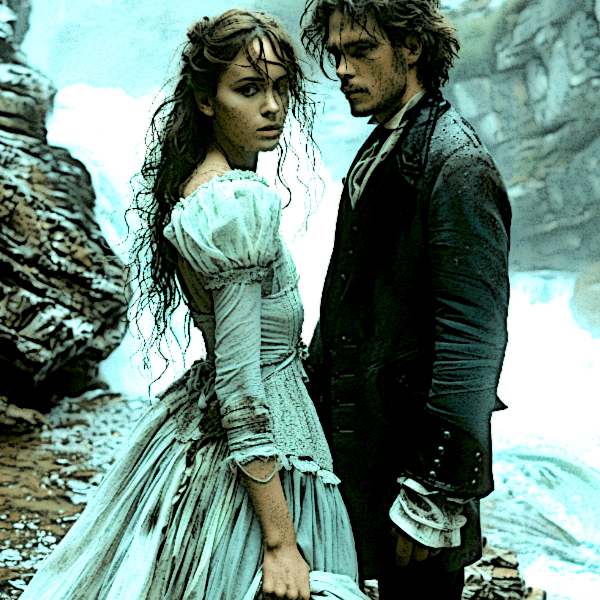
Image AI made by MidJourney