Pet Peeves

When reading a romance novel, I think it’s safe to say we all have our pet peeves. Perhaps many.

Inconsistent descriptions get me every time. Sometimes, it’s just sloppy editing and, though annoying, doesn’t really ruin a good story. Like when a character’s eye color changes or descriptive elements are left out but prove important to the story.

My current source of irritation was perfectly illustrated in a novel I was deeply engrossed in. During the climactic scene, the layout of a house kept changing. It seemed that all exits and entrances were from the kitchen, which was ludicrous because it was set in a stately home. The kitchen seemed to be near the front door, library, and drawing room all at once. I could not figure out which rooms were upstairs or downstairs. Characters entered the drawing room and exited the library.

An excellent book that had me totally invested was ruined because I could not properly visualize people’s movements throughout the action.
Sad really. Visualization is very important to me. Books are like movies running through my head.

What are your pet peeves?

Excerpt from a deleted scene Marry Me, Duke

“He slipped the ring onto her finger, sealing their promise and giving her a light kiss, and then the pressure was gone, and her lips were cold from his absence.
As she walked out of the chapel, hand in hand with her new husband, he glanced down at her with that same impassive and steady look in his eyes. “It’s for the best,” he said, perhaps seeing her doubt. “I promise you. We will make it work.”
He sounded as though he were trying to convince himself, and deep within her being, she knew that Hugh’s love for her was fragile—if it existed at all. In that instant, a chilling realization struck her, unraveling the dreams she clung to—she was on the brink of a grave mistake.”

What makes a relationship romantic?

Respect: Mutual respect is key to a romantic relationship. Each partner should value and appreciate the other’s opinions, boundaries, and individuality.
My favorite historical novels are those where the main male character goes against societal norms in that he actually respects the main female character. If he admires and supports her, all the better. Yes, this is atypical for the time periods that I read and write in, but this is a trait that makes you absolutely fall in love with the hero.

A Writer’s Corner – Writing Love Scenes

The love scenes are the most difficult scenes to write. In my books, I thought I handled the emotional part of desire very well but did not handle the Instalove and obsession well at all. This is so much a part of the romance genre, and it has always felt very unconvincing to me. It is very juvenile, yet it is so popular.
My characters are more ‘mature’ in that they don’t fall in love immediately. They are attracted, intrigued, and often baffled by this. There is a lot of wariness and uncertainty until the very end.
It’s hard to identify the moment when real love happens. We don’t even see when that happens in real life, so how can we capture that moment in a novel?
There’s a scene in my most recent novel, Marry Me, Duke, where the female main character all but begs her new husband to make love to her. That was such an enjoyable scene to write. For one, you don’t often see this in historical romance novels. Her lust and curiosity seem very real to me—as is his rejection. When they finally do make love, she takes the lead at first. And after that point, he gradually falls in love with her. That, to me, felt more realistic than Instalove/lust would have.

What makes a relationship romantic?

Shared Goals and Values: A romantic relationship flourishes when both partners have common goals, values, and aspirations. I love it when the two main characters are working together for a common cause. I love mysteries, and I’m a sucker for a good historical mystery where the female main character pairs up with a detective, and they work together, and sometimes against each other, to solve a crime, unravel a mystery, or save someone.

What makes a relationship romantic?

Quality Time: Spending meaningful time together strengthens the romantic bond. Whether it’s through shared activities or simple moments of togetherness, quality time fosters a deep connection.
Time spent together helps to build the romantic momentum in a novel. In historical romance, this is most easily done when the characters are thrown together during a house party. They have a legitimate reason to be around each other 24/7. During these scenes, the bonds can be formed at a very good pace, and the characters can easily be thrust into semi-intimate contact.

In my second novel, Marry Me, Duke, my main characters have a forced proximity that allows them to get to know each other well and go through their emotions while still maintaining proximity. In my first novel, A Misalliance with Love, the main characters spend much of their time away from each other, thinking about one another. Because of this, the emotional bond, perhaps, isn’t as strong. The novel ends with the promise of this bond and the chance to forge a connection.

What makes a relationship romantic?

Surprises and Thoughtfulness: Thoughtful gestures and surprises demonstrate that partners are attentive to each other’s needs and desires. It could be as simple as a heartfelt note, a surprise date, or a small gift.
This is such a sign of a true romantic, and it’s a pity that we don’t see more of it in historical romances. There’s plenty of flower giving but a few real surprises. I love it when the main male character knows that the main female character needs something or wants something very badly and makes sure that she has it, even if the gift is given anonymously. The best example of this is in ‘Sense and Sensibility’ when Marianne Dashwood receives the piano without knowing that it was sent by Colonel Brandon. That was very romantic.

A Writer’s Corner – Prologue

Do readers like prologues or skip them? This question was asked in a writer’s forum I belong to, so the answers were from writers rather than readers.

Some think that readers skip over prologues, mistaking them for a book’s forward, rather than understanding that the prologue is a necessary part of the story.

Of course, it’s not always necessary. Sometimes, a prologue, if badly written, is nothing more than an info dump. I was surprised to see that many writers feel that prologues are unnecessary or misused. There was a lot of mention of fantasy novels, in particular, which seem to be overweighted in character and environment history.

I like prologues, and I always read them. I feel that if a novel has a prologue, then it is really for a reason. I wrote a prologue for my second novel and have one in my work in progress.

In my last novel, Marry Me, Duke, the prologue could have been chapter one. It gave the reason why an event happened later. I did not want this reason to have to be explained. I wanted readers to see it and register it so that they would not later be surprised or have questions about the actions of a certain character.

I dislike when the reason for an action has to be explained in a book. I would rather put all the pieces of the puzzle together myself and come to a conclusion, particularly for pivotal moments. The worst thing for me as a reader is having to scratch my head and wonder at a character’s motivations when we should have already seen some foreshadowing.
For this reason, I always read prologues and write them when they’re part of the story that will inform future action or an action in the past that the reader must know about.

In my work in progress, the prologue covers an event fifteen years prior to the main story. It defines the main character. If I didn’t have the prologue, a pivotal event in chapter one would not have the same impact. The reader response would be curiosity rather than ‘uh-oh there’s trouble coming.’ Without the prologue, the explanation would have to be told much later instead of seen, and I think it would not have been as impactful.

In general, I use prologues to show why something happened rather than awkwardly explaining it.

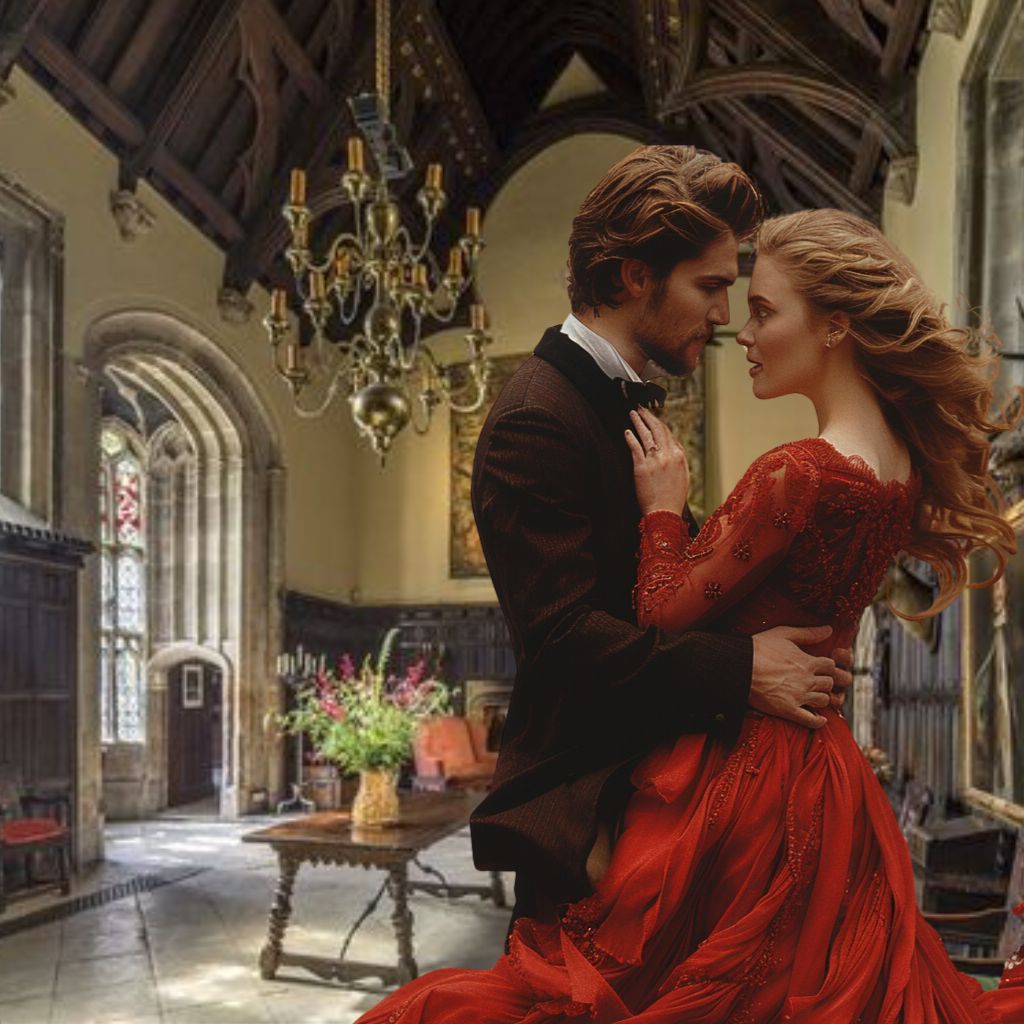
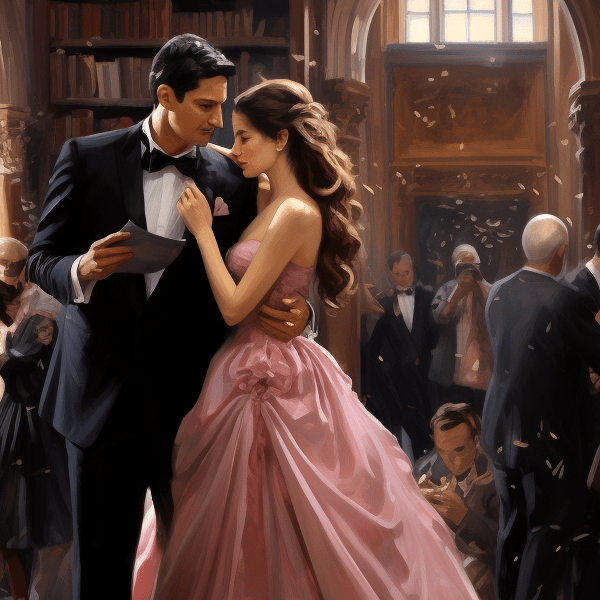
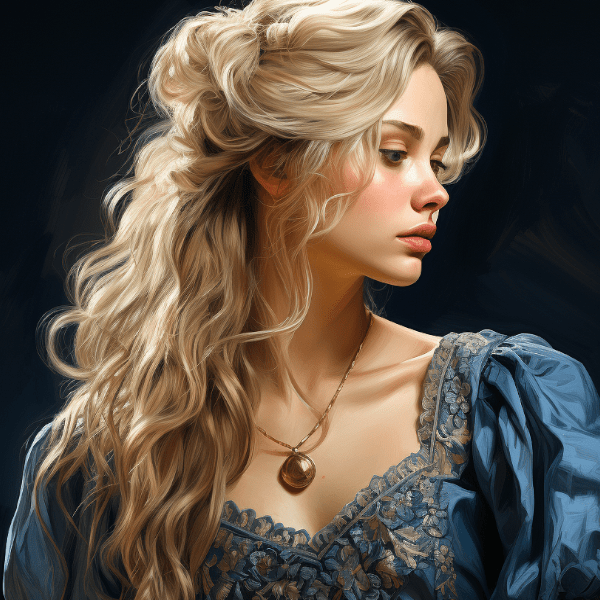
Image AI using MidJourney

My Take on Romance and Intimacy

Physical and emotional intimacy plays a significant role in a romantic relationship. This involves not only the physical aspects but also the sharing of personal thoughts, fears, and dreams.

I choose to write ‘closed-door’ romances, preferring to concentrate on the emotional buildup between the main characters.

Nothing against spicy novels, but sometimes I find the constant emphasis on the physical takes away from the story and can make the emotional intimacy unbelievable.

Which do you prefer? The physical, or the emotional?

The love of the historical romance

My love for Regency romance novels – and writing them – is a tribute to the genre’s ability to provide an engaging blend of history, romance, and escapism. The elegance of the historical era, be it Regency, Victorian, or any other, coupled with strong characters and timeless love stories, creates an experience that I continue to find enchanting and enduring.

Check out ‘A Misalliance with Love’ and ‘Marry Me, Duke’ where you can enter the enchanting world of the Victorian debutant. https://amzn.to/3RVBJLD

On Valentine’s Day, Marry Me, Duke will be released to Kindle Unlimited!

Happy Reading!

Image generated using AI – Midjourney.