Strong, Independent Heroines

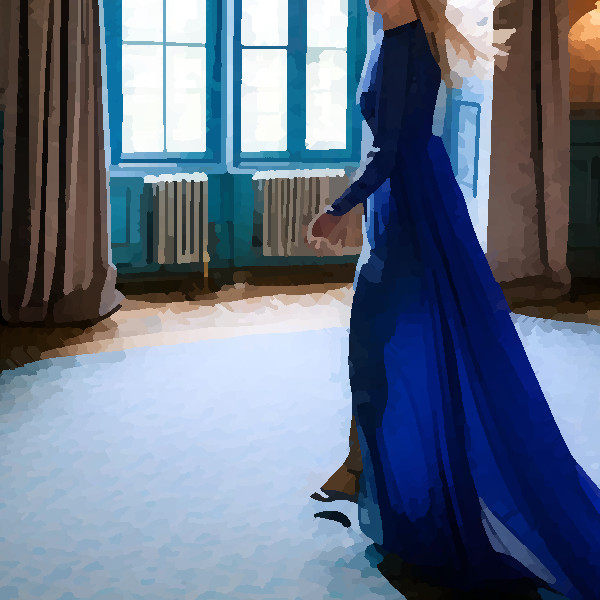
Regency and particularly Victorian romance shows us strong-willed heroines who defy societal norms. These women navigate a world that expects them to conform, and their resilience is both empowering and inspiring.

My favorite recent ‘girl power’ heroine is the main character in the Miss Scarlet and the Duke masterpiece series. She’s running her own business and coming up against people who believe she should conform to society’s views of what a gently raised woman should be, and ladies certainly do not view corpses and fight villains. Witnessing these characters’ trials and journeys of self-discovery resonates with modern sensibilities.

I have always loved a strong heroine. The fearless women who buck the trends and stomp through life, taking no prisoners, are the best female main characters written. They are fun and exciting.

These are the characters I try to write because these are the ones I love to read. But sometimes, I do stray from this trope. I love a shy character who becomes the person she is meant to be. I love proud accomplishments by the underdog.

My work in progress, ‘An Unexpected Lady’, is about a shy woman who experienced an early childhood trauma that is barely remembered but instrumental in forming her personality. Love makes her bold, strong and determined to pursue her passions-one of which being a certain gentleman. The male main character will draw her out of her shell while having reason to be suspicious of her. Oh, what a tangled web I’m weaving.

Check out ‘A Misalliance with Love’ and ‘Marry Me, Duke’, where the women are strong and fight for what they want. https://amzn.to/3RVBJLD

Image generated using AI – Midjourney.

Historical Intrigue

Regency novels and shows are often set against the backdrop of historical events, which add a layer of intrigue and authenticity. From political unrest to major societal changes, these stories give us a glimpse into the challenges and triumphs of the time. There can be a captivating blend of history and fiction that enhances the overall narrative.

Some of my favorite tropes include romance during the Napoleonic wars, and most recently, I am enthralled by Victorian Era social changes for women. The Married Woman’s Property Act was a game changer that gave women the right to their own property. This makes a huge difference between Regency and Victorian Romances.

In the books I write, which are Victorian, I plan to continue giving women their own property. I confess I always despised the helplessness of Regency women and how everything was taken from them. They were always at the mercy of the men around them. Though I love the time period, this grates on the nerves. Setting novels in the Victorian era eliminates this default helplessness to a degree and I enjoy reading and writing these novels because of it.

Check out ‘A Misalliance with Love’ and ‘Marry Me, Duke’ – my novels, on Amazon. The women are strong and fight for what they want.

Image generated using AI – Midjourney.

Slow burn in Romance novels

At the core of Regency romance lies a timeless love story. Whether it’s the tension between headstrong heroines and brooding heroes or the delicate dance of courtship, the genre weaves tales of passion and love that resonate across generations. The slow burn of romance builds anticipation, keeping me eagerly turning the pages or glued to the screen.

But I also enjoy how the genre has adapted to modern times, and in a sense, current Historical Romances are far more realistic than classical novels. There is sex – and lots of it – often before marriage. And I do believe that that is more realistic than the old-fashioned view that everyone had the discipline to wait until the vows were said, and no one had uncontrollable urges.

My novels are closed-door (sex is implied and not explicit) simply because I love writing about characters more than action. I love the tension and slow build and then a hint of passion.

In my recent novel, Marry Me, Duke, there is a scene (spoiler alert) where the main character, Ginny, is in a marriage that has not yet been consummated. She is chomping at the bit and her husband Hugh has his reasons for holding back.

She is very attracted to her husband and is baffled by his reticence. In one scene, she gives Hugh a massage, and it leaves her wanting and unsatisfied. I confess I loved writing that scene. I could feel her frustration – and his as well. I think I would have liked the scene much less if it had been explicit, and I hope I left readers wanting more.

Oh, how I love a slow burn.


Image generated by AI – Midjourney

A Misalliance with Love

“I know it seems that I’m dithering, but we will have to live separately,” she said, resignation weighing her down. “I will not take a place beside him in society. I will not attend these horrible functions. I will not throw dinner parties for him. We will live apart and will have a marriage in name only.”

Excerpt from A Misalliance with Love.

A Writer’s Corner – Seeing the Characters

In a forum, someone asked: Do authors have a clear idea what their characters look like? I 100% cast my characters as if the book were a movie.

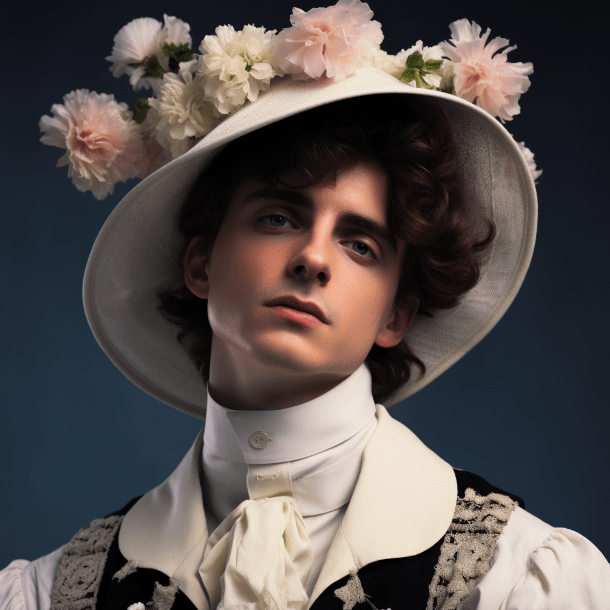
I confess I do, too. In my next book, How to Care for a Duke Hugh, the Duke of Albemarle, looks like Timothee Chalamet. I see the tousled hair and a relaxed, lanky body. While the main female character, Ginny, looks like a russet-haired Elizabeth Moss. The Dowager Duchess is a slightly older-looking Joely Richardson.
The secondary characters are less defined. The evil protagonist, the duke’s cousin, looks like Ralph Fiennes with a trim beard. Intense eyes and a sharp face. I love seeing these actors as my characters.

I experimented with Midjourney, trying to build my mood board for the book, and came up with the fabulous but totally wrong portrait of Hugh. I wanted Hugh and Ginny with her wearing the hat. This is such fun, though.

Image generated by AI using Midjourney.

A Misalliance with Love

“The interior of the House of Lords was designed to impress and awe visitors with its lavish decorations and furnishings. The walls were hung with richly colored tapestries and paintings depicting scenes from British history.
However, he couldn’t shake the feeling that his colleagues were more concerned about their own political gains than his well-being.”

Excerpt from A Misalliance with Love.

Image generated by AI using Midjourney.

How to Care for a Duke

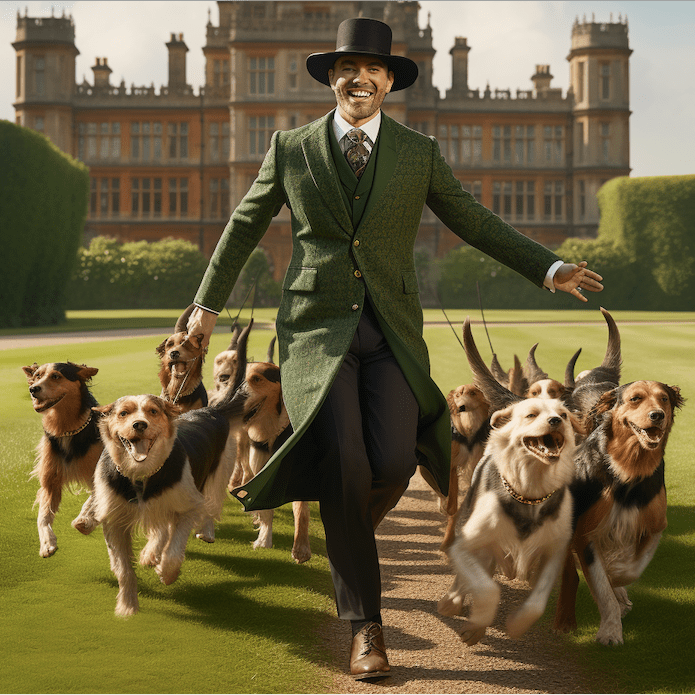
I’m giving you a picture from my mood board for How to Care for a Duke.

A Duke with a mysterious illness has many dogs and other animals and a will to live, especially when he falls in love with his bossy caretaker. I’m hopeful this second novel will be out in December.

Meanwhile, check out ‘A Misalliance with Love‘.

Image generated using AI Midjourney.

A Misalliance with Love

“She couldn’t ask Sinclair to stay by her side. Nor could she muster the courage to accompany him to London, where she would have to work hard to be the person he wanted, only to face the pain of rejection once more.
He planned to return to London in the morning. And she would let him go—alone.”

A Misalliance with Love

Image generated by AI using Midjourney.

Sinclair’s Dilemma – A Misalliance with Love.

“The cool evening air soothed his raging mood as he left the House of Lords. He waved off his carriage and continued to walk towards St. James. The early evening was damp, and he turned up the collar of his topcoat. He had wanted to redeem himself in the eyes of society by working hard and showing himself, to be honest, serious, and reliable.
All of that was ruined now, and he looked like a fool. Like his father! Sinclair felt incensed at the unfairness of it all. He was not responsible for what happened but must do all he could to limit the damage. He must get Rosie to be a real wife, even if he had to go straight to Castle Holme and haul her back to London.”

Excerpt From: Dee Harper Lewis. “A Misalliance with Love.

A writer’s dilemma: Adding character flaws

There was an interesting thread in the Reddit writing community about how to avoid making a character too perfect. (How can i avoid writing/creating Mary sues)

The comments and suggestions were great and well worth a read. The consensus was that the character must be given a flaw or a weakness. I agree and believe the flaw is most interesting when it interferes with the character’s goals. This is important for secondary characters as well.

I find male protagonists often painted as either totally flawed or too perfect and unattainable. Female characters who are imperfect are far more interesting, particularly if the writer allows the reader to discover why they have these imperfections.

The character I’m writing now is a bit of a Pollyanna, saved from being unbearable because, although she does good, she complains about it and wants to stop being forced to do good. Her escape route from this life makes her look like an opportunist. Not a good look, but somehow, you can’t hate her for it.

Rosie, in A Misalliance with Love, listens to other people’s conversations and is too rigid in her thinking, and Sinclair is trapped by his family’s past.

There are so many ways to take the shine off of a character to show they are not so perfect after all. It’s even more interesting if this is revealed slowly.

Image generated by Canva and digitally manipulated.